
What Is an Arc Flash?
An Arc Flash is a sudden electrical discharge that travels through air between energized conductors or from a conductor to ground. The discharge creates intense heat, bright light, sound, and pressure. Arc flashes often begin when a fault, damaged insulation, loose connection, or conductive object creates an unintended path for current.
Quick Facts About Arc Flash
Category
Electrical safety hazard
Used for
Identifying fault and equipment risks
Common confusion
Confused with arc-fault protection
Also called
Arc Flash Incident, Electrical Arc Flash
Often discussed with
Electrical Safety Inspection, Electrical Code Correction
Key Takeaways About Arc Flash
- An arc flash travels through air during an electrical fault.
- Loose connections and damaged insulation can create arc flash conditions.
- An arc flash is not the same as an arc-fault breaker.
How Arc Flash Works

Arc flash begins when electrical current leaves its intended path and crosses an air gap. The air becomes conductive, allowing the current to form a bright electrical arc. The event can release heat, light, pressure, and vaporized metal near electrical equipment.
Related glossary terms: Arc-Fault Circuit Interrupter, Short Circuit, Overcurrent.
Electrical professionals assess arc flash risk by examining available fault current, equipment condition, conductor spacing, and protective device operation. An arc-fault circuit interrupter detects certain unwanted arcs and can disconnect a circuit. An arc flash describes the event itself, while arc-fault protection describes equipment designed to interrupt some hazardous arcing conditions.
During an Electrical Safety Inspection, visible damage, loose terminations, inadequate enclosure condition, and signs of overheating can point to conditions that deserve further evaluation. These observations help connect equipment condition with the possible behavior of a fault.
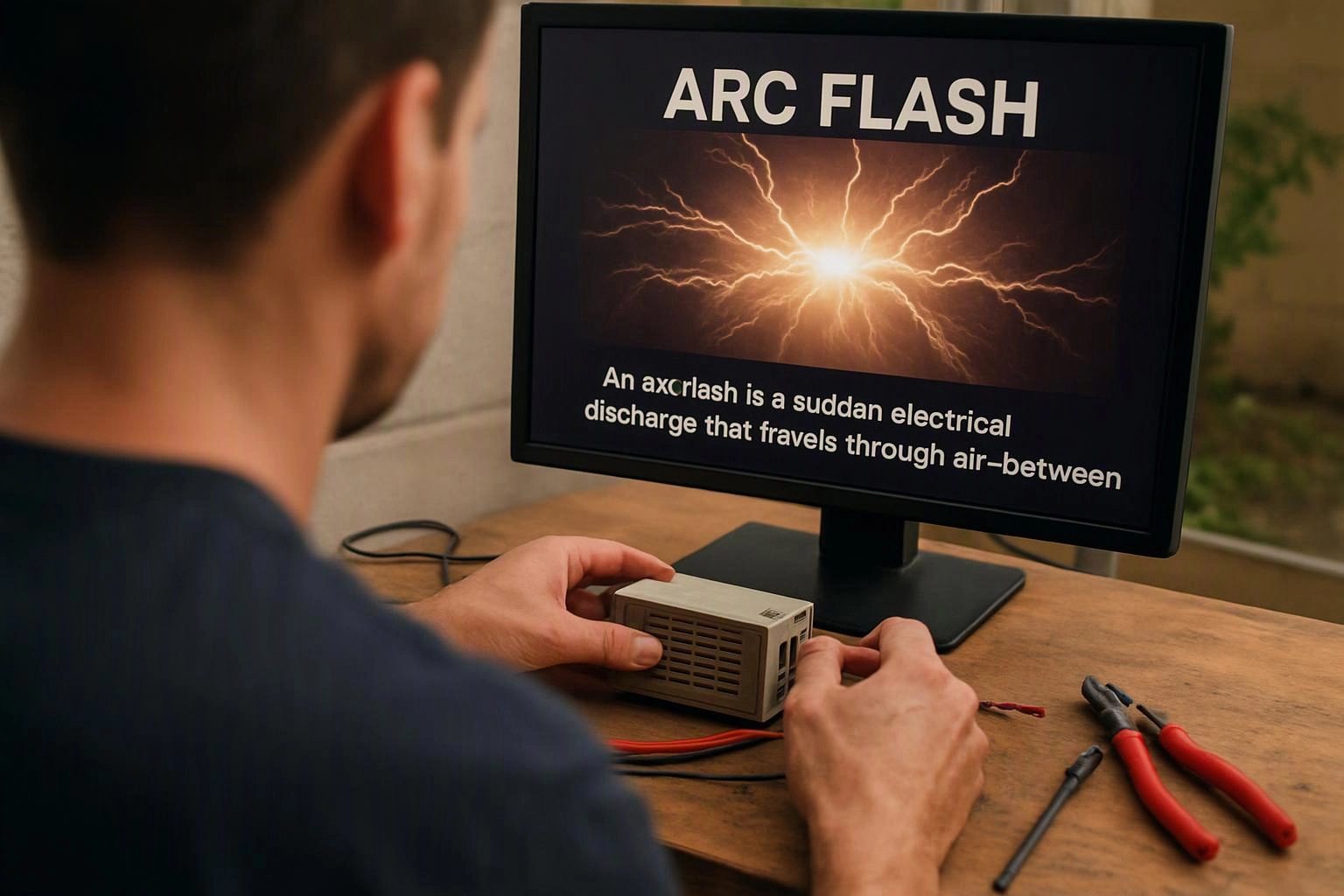
From the Center Electric Service team
When we inspect electrical equipment, we look for damaged insulation, overheated connections, loose terminations, and enclosure problems that could support an arc event. We also review panel condition and protective devices as part of the broader Electrical Safety Inspection. Our findings focus on observable conditions and the corrective work they may require.
Arc Flash in Practice: A Real-World Example
During an Electrical Safety Inspection, a technician may find discoloration around a panel connection and insulation that has deteriorated. Those conditions can allow an electrical fault to form an arc, so the connection and surrounding equipment need closer evaluation.
Related Terms
Arc-Fault Circuit Interrupter
An Arc-Fault Circuit Interrupter is a protective device that detects electrical arcing and opens a circuit…
Short Circuit
A short circuit is an unintended low-resistance path between electrical points that should remain separate. The…
Overcurrent
An overcurrent is an electrical flow that exceeds the safe capacity of a circuit, wiring system…
Main Breaker
A Main Breaker is the primary overcurrent protection device in an electrical panel. The device controls…
Center Electric Service
Have Questions About Arc Flash?
Contact Center Electric Service for practical guidance on Arc Flash and related 24 hour electrician work in Riverside.